

OUR FINISHES
Tumbling
Tumbling is a mechanical finishing process used to refine the surface of metal components
Our Strengths
Applications of Tumbling
Efficiency on Large Batches Simultaneous treatment of high volumes of small parts with unbeatable cost-effectiveness compared to manual finishing.
Surface Uniformity The three-dimensional abrasive action reaches every corner of the part, ensuring a consistent visual appearance across the entire surface.
Non-Invasive Treatment Gentle smoothing that improves smoothness and reduces surface friction without mechanically stressing the component.

tumbling, process & characteristics
_ tumbling process & characteristics

Metal tumbling is an essential process for improving the surface finish of metal components and preparing them for subsequent treatments such as painting, nickel plating, or polishing. The procedure takes place using automatic machines where the parts are immersed together with abrasive cones that vibrate continuously, eliminating burrs and imperfections resulting from molding, cutting, or machining.The abrasive action, often carried out by ceramic stones, allows for a uniform and semi-glossy surface, making the metal smooth and ready for further processing. In addition to aesthetic improvement, tumbling contributes to increasing the fatigue resistance and durability of the components. It is a technical and specialized process, adaptable to different finishing needs and the quality standards required by the industry and the customer.
l Industries Served
Automotive
Biomedical
Hydraulics
Furniture & Design

machinery
e controls utilized
_ machinery
e controls
utilized

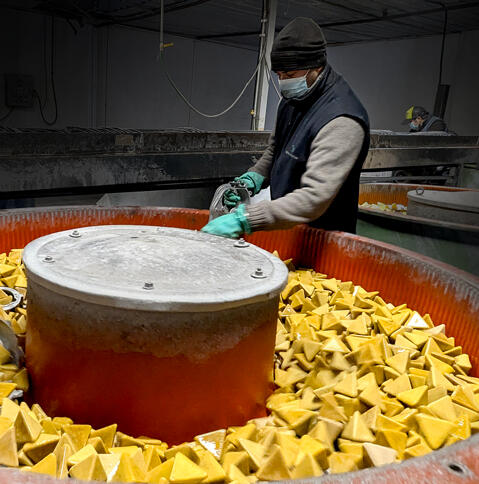
l Vibratory Tumbler
The vibratory finishing machine (or vibro-tumbler) finishes metals through mechanical vibratory action. In a polyurethane-lined toroidal bowl, motors with eccentric weights generate three-dimensional vibrations ($25$–$50$ Hz) that move the mixture of parts, ceramic or steel abrasives, and water in a continuous toroidal motion. This intense friction removes burrs, oxides, and scale, rounds edges, and polishes surfaces. The cycle, ranging from minutes to hours, is managed by a timer.
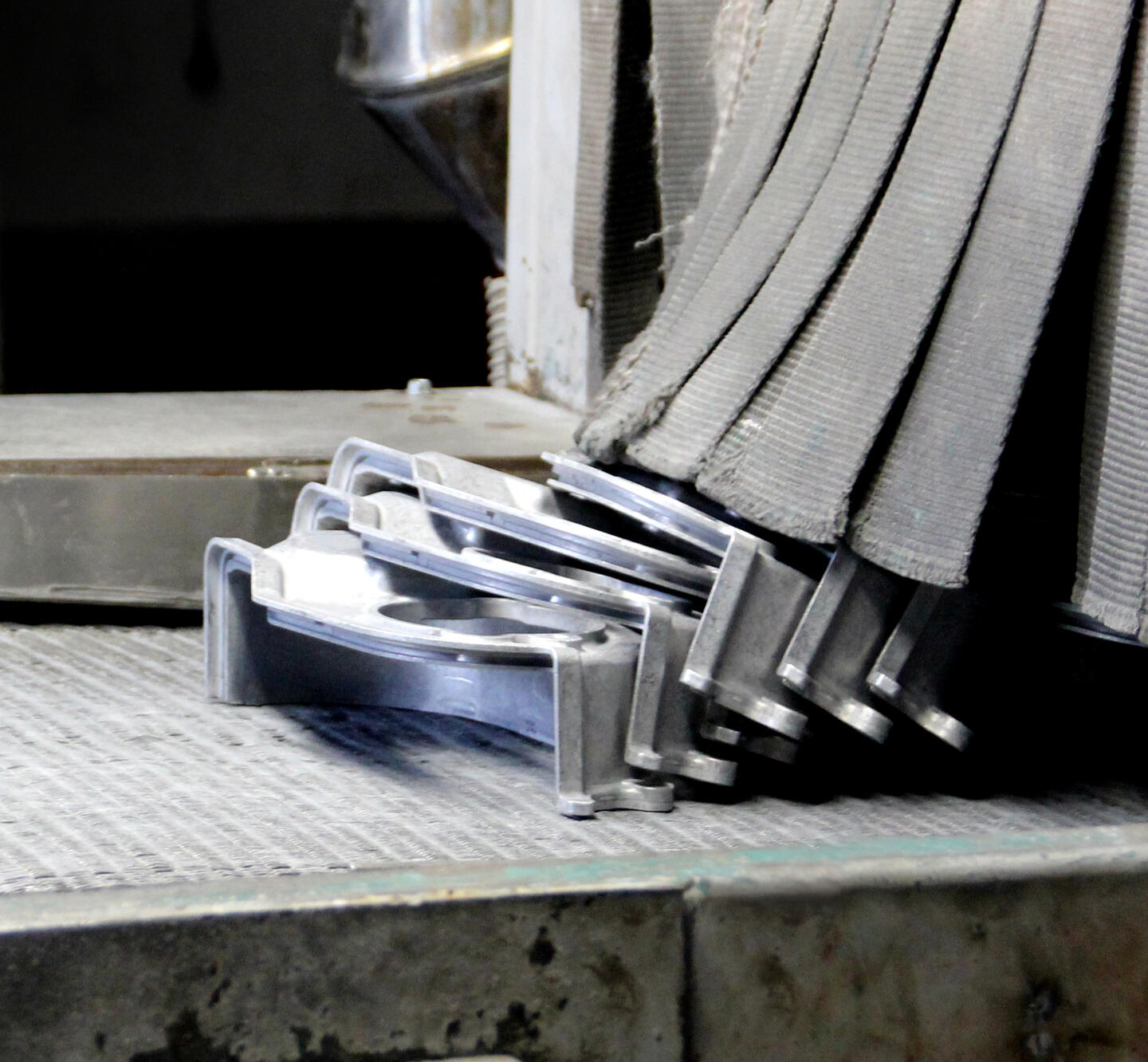
l Washer and Hot Air Dryer
The continuous parts washer treats metal components on a perforated mesh belt through sequential zones: spray pre-washing and hot air drying (80-120°C). The cycle, managed by a PLC with in-line temperature and conductivity control, lasts 3–8 minutes. Components emerge perfectly clean and dry, ready for immediate painting or assembly, ensuring uninterrupted batch production.
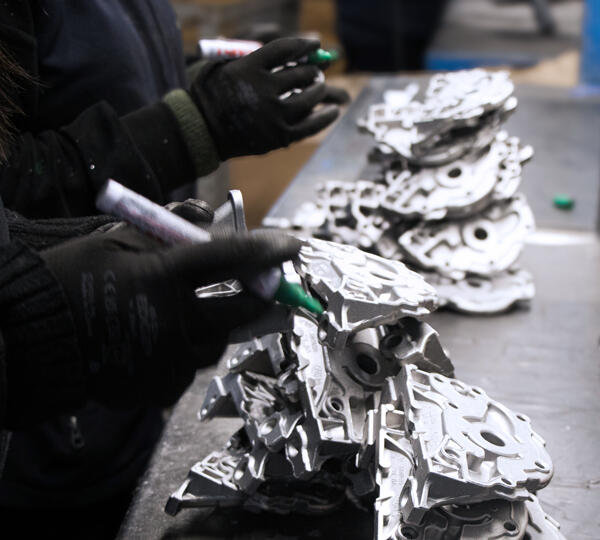
l Visual Inspection
Post-tumbling visual inspection examines metal components exiting the vibratory finisher: the operator verifies surface quality, edge rounding, and the absence of defects by inspecting each part on a conveyor belt or a light-colored workbench. It detects embedded abrasive residues, chemical streaks, chipping, residual burrs, or color alterations. The process takes a few seconds per part and allows for the identification of anomalies in the vibratory finishing process—such as media wear, insufficient cycle time, or incorrect chemical solution concentration—requiring immediate corrective actions.

_ link & download
_ link &
download

Download informative materials and specifications to learn more about our processes, our methodology, and how we guarantee our high quality standards:
Industries Served
Procedures & Quality

_ FAQ _
(Frequently Asked Questions)
_ FAQ
(Frequently Asked Questions)


Via Collebeato 22 | 25127 Brescia | ItalyP.Iva C.F. 04150990986 | Rea BS 592530 | Cap. Soc. 20.000 I.V.
